Advances in office technology and the upgrades that replaced them
 | January 6, 2026 | 11 min read |
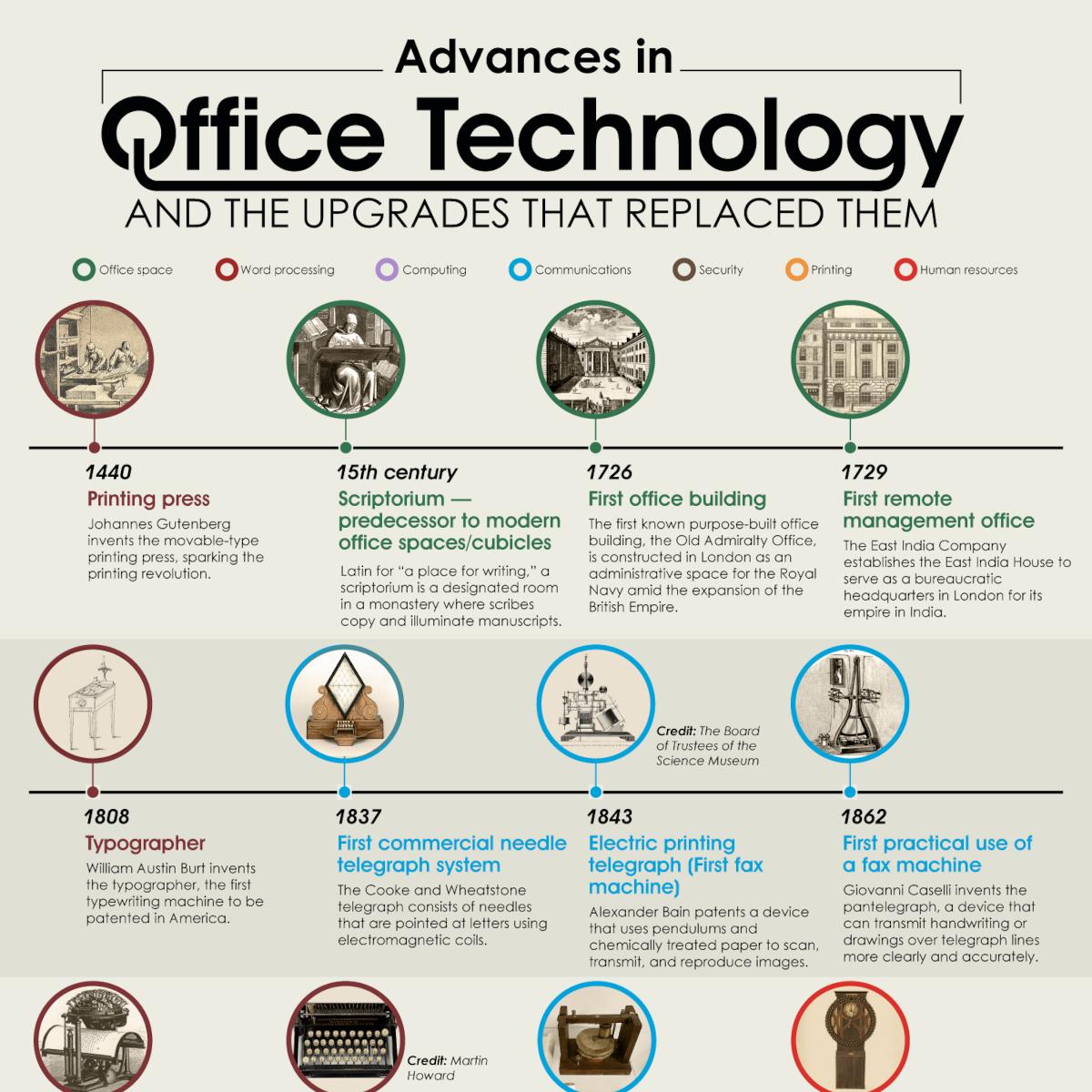
Enter most offices today and you’ll see keyboards, glowing screens and employees at workstations, busy with emails, instant messages and video calls. These technologies have become so essential in our professional environments that it’s hard to imagine working without them. However, the modern workspace didn’t develop overnight, and every device and system we rely on today has a predecessor that paved the way for what we use today. From the ink pots and ledgers of the late Middle Ages to today’s cloud-based platforms and smart devices, the office evolution has been a testimony to the pioneering spirit of humankind.
In appreciation of how far we’ve come, Ooma has cracked open the history books to explore the evolution of office technology, the inventions that transformed the workplace and the innovations that continue to change it.

Office space
The scriptorium was the earliest forerunner of the modern office. This room served as a dedicated space in 15th-century monasteries where scribes meticulously hand-copied manuscripts. Centuries later, the Old Admiralty Office opened in London in 1726, becoming the first building specifically intended to be an office. By the 19th century, paperwork and correspondence required entire departments dedicated to clerical tasks, turning offices into hubs of commerce and communication. The next major leap in the history of the office didn’t occur until 1984, with the creation of the first “smart” office building, Cityplace. This facility in Hartford, Connecticut, used a fiber-optic network to connect and automate its internal systems, like heating, lighting and security.
Word processing
The struggle to efficiently get thoughts onto a page is as old as writing itself. The history of printing and modern word processing begins long before the first office existed, with Johannes Gutenberg’s movable-type printing press in 1440. This invention sparked a revolution in communication, but for centuries afterward, getting words onto a page remained a largely manual process until the 19th century brought mechanical relief. Although the first typewriting machine was invented in 1808, it was the 1873 Sholes and Glidden typewriter that set the standard with its QWERTY keyboard layout we still use today. This invention forever changed the pace and appearance of business correspondence.
The 20th century saw the arrival of IBM’s Selectric Typewriter in 1961, but the true revolution was the IBM MT/ST, the first word processor, introduced in 1964. For the first time, a user could edit text recorded on magnetic tape without needing to retype the entire document. By the 1970s, computer programs like Bravo introduced WYSIWYG (What You See Is What You Get) interfaces, simplifying document creation. It wasn’t long before Microsoft Word stepped in and refined the experience.
Computing
No piece of technology defines our modern offices more than the computer. Prior to electronic computers and calculators, calculations were performed with hand-operated tools such as the abacus, a simple counting instrument that has existed in various forms across the globe since ancient civilization. As calculations became more time-consuming and complex, “human computers” became an occupation starting in the 17th century. These impressive individuals manually performed mathematical calculations for science, aerospace, and military projects. One distinguished example is NASA’s Katherine Johnson, a human computer who played a critical role in making early space flights possible. In fact, astronaut John Glenn refused to fly until she personally verified the calculations of NASA’s early electronic computers.
When was the first electronic computer invented? It all began in 1946 with ENIAC (Electronic Numerical Integrator and Computer), the first general-purpose electronic computer. Compared to today’s machines, its computing power and size would be laughable, but at the time, it is believed to have performed more calculations than all of mankind had done up to that point combined! This technology was quickly applied to office work: By 1951, the Lyons Electronic Office (LEO) had automated payroll systems for J. Lyons and Co., marking the debut of the first office computer designed for routine tasks.
These early machines were enormous and accessible only to large organizations. The turning point came with the development of the personal computer. The Xerox Alto, introduced in 1973, was the first system to include a monitor, a mouse and a graphical user interface, features now considered standard. However, it was the IBM Personal Computer, released in 1981, that truly popularized computing for the masses and revolutionized business operations on a global scale.
Today, the evolution of office technology continues with the arrival of AI use in the workplace. In fact, roughly 30% of users now use artificial intelligence for work-related tasks. We owe this to the incredible brainpower of the human computers that paved the way. After all, the computational models that make artificial intelligence possible are inspired by the human brain and its knack for complex problem-solving.
Communications
Before electronic means of communication, offices communicated through physical delivery (messengers, mail, pigeons), visual signals (smoke, fires, semaphore flags, mirrors and lights), and auditory cues (drums, horns, cannons). Then came the telegraph; messages could be sent via a wire in the form of dots and dashes, or Morse Code. This mode of communication became so prevalent that Western Union (then-leader of the telegraph industry) refused to buy the patents for the telephone when Alexander Graham Bell presented them. In 1876, he made the first telephone call, enabling live conversations between businesses thousands of miles apart for the first time in history. Despite the initial skepticism, the invention of the telephone would eventually lead to the introduction of more office staples.
In the early 20th century, fax machines were introduced, and by 1985, software like GammaFax allowed for faster file transmission between PCs and fax machines. While email and internet replaced fax machines in some capacity, they are still widely used in the legal, government, and healthcare sectors due to their security.
In 1971, the first email was sent on ARPANET, a pioneering U.S. government network that laid the foundation for the internet. In 1989, the World Wide Web was unveiled, and then in 1993, it was released to the public domain, forever altering the way we communicate at work and beyond. This enabled the introduction of Voice over Internet Protocol (VoIP), a now widely-adopted technology that allows voice communication over the internet instead of traditional phone lines. More recently, services like Zoom and Slack ushered in a new era of digital collaboration, compelling other tech companies to create versatile office communication platforms.
Security
Before technology both improved and complicated the workplace, office security began with watchmen protecting assets. The art of protection began during ancient times; for example, Roman emperors had bodyguards known as Praetorian Guard, an elite unit responsible for providing safety and intelligence. In Medieval Europe, knights served as security personnel for the nobility and their property. As factories and large-scale enterprises emerged during the Industrial Revolution, the demand for dedicated security personnel increased extensively. This led to the establishment of Allan Pinkerton’s Agency, America’s first major private investigation agency and security company. Now one of the world leaders in the risk management industry, Pinkerton’s trajectory serves as a historical record of how office security has evolved.
While the need for physical security continued into the 20th century, digital security became a more pressing issue as technology became more integrated into the workplace. Early advances included IBM’s magnetic stripe cards in 1960, which allowed companies to manage access to buildings and sensitive areas. With the arrival of networked computers came a new kind of threat: malicious software. The first antivirus software, called Reaper, was developed in 1972 to combat an experimental self-replicating program on the ARPANET, marking the beginning of the cybersecurity field. Sony’s AI-enabled image sensors marked another milestone in 2020 by integrating security cameras with real-time processing capabilities.
Printing
Before the printing press revolutionized the distribution of paper materials, scribes in monasteries were hard at work copying and illuminating manuscripts. These marvelous, meticulous projects would take anywhere from months to several years to complete. This craft continued strong until the invention of the printing press around the 1450s, which made mass print production possible.
While the printing press was a major step for this sector, the modern story of office printing truly began in the 20th century. The Xerox 914 in 1959 made photocopying quick and accessible, followed soon after by dot matrix and laser printers, which made high-quality printing affordable to the masses.
By 1993, publishing and marketing were forever changed by the introduction of digital color printing with the Indigo E-Print 1000. Today, offices use networked printers capable of scanning, copying, and sending digital documents directly to cloud storage.
Human resources
The history of office technology wouldn’t be complete without mentioning human resources technology, including the first punch time clock in 1888, which allowed for more accurate timekeeping. Before time clocks, workers tracked time with rudimentary methods like incense, sundials, or the taking and returning of stones or tokens to mark shifts. In more formal work settings, supervisors would manually track the arrival and departure times of workers in ledgers.
Like everything else in the office, computers have completely transformed human resources, too. The founding of PeopleSoft in 1987 brought the first major software system dedicated to managing HR and finance tasks. And time clocks have evolved from punch cards to biometric fingerprint systems in the 1980s and cloud-based facial recognition systems in 2011.
From typewriters to tablets, from fax machines to cloud collaboration, every invention reflects humanity’s drive to connect and communicate more efficiently. If your business is ready to embrace the next generation of communications, Ooma can help. Contact us today to learn more about our flexible, reliable and intelligent communication solutions that keep your teams connected, wherever work takes place.
The evolution of office technology
| Year + Development | Description |
|---|---|
| 6th century — Scriptorium (Office space) | Latin for “a place for writing,” a scriptorium is a designated room in a monastery where scribes copy and illuminate manuscripts. |
| 1440 — Printing press (Word processing) | Johannes Gutenberg invents the movable-type printing press, sparking the printing revolution. |
| 1726 — First office building (Office space) | The Old Admiralty Office is constructed in London as the first known purpose-built office building. |
| 1729 — First remote management office (Office space) | The East India Company establishes East India House as a bureaucratic headquarters in London. |
| 1808 — Typographer (Word processing) | William Austin Burt invents the first typewriting machine patented in America. |
| 1837 — Commercial needle telegraph (Communications) | The Cooke and Wheatstone telegraph uses electromagnetic needles to transmit messages. |
| 1843 — Electric printing telegraph (Communications) | Alexander Bain patents an early fax-like device using chemically treated paper. |
| 1862 — Practical fax machine (Communications) | Giovanni Caselli invents the pantelegraph, capable of transmitting handwriting and drawings. |
| 1865 — First commercial typewriter (Word processing) | Rasmus Malling-Hansen introduces the Hansen Writing Ball. |
| 1873 — First QWERTY typewriter (Word processing) | The Sholes and Glidden typewriter establishes the QWERTY keyboard standard. |
| 1876 — First office telephone call (Communications) | Alexander Graham Bell makes the first telephone call to Thomas Watson. |
| 1888 — First punch time clock (Human resources) | Dr. Alexander Dey invents a dial-based employee time recorder. |
| 1890 — Key-based time clock (Human resources) | Bundy Manufacturing mass-produces employee key punch clocks. |
| 1894 — Punch card time clock (Human resources) | The Rochester Recorder prints clock-in and clock-out times on employee cards. |
| 1897 — Visible typewriter (Word processing) | The Underwood 1 allows typists to see text as it is typed. |
| 1900 — International Time Recording Company (Human resources) | Time-recording companies merge to form ITR, later known as IBM. |
| 1904 — Offset lithography (Printing) | Ira Rubel develops a printing technique using an intermediate surface. |
| 1914 — First electric typewriter (Word processing) | James Fields Smathers creates the first practical powered typewriter. |
| 1924 — Wireless fax machine (Communications) | A photo of President Calvin Coolidge is transmitted from New York to London. |
| 1935 — IBM electric typewriter (Word processing) | IBM enters and dominates the electric typewriter market. |
| 1938 — First photocopier (Printing) | Chester Carlson patents electrophotography, later called xerography. |
| 1941 — Proportional spacing (Word processing) | IBM introduces proportional spacing to improve text readability. |
| 1946 — ENIAC (Computing) | The first programmable, electronic, general-purpose digital computer is completed. |
| 1951 — Lyons Electronic Office (Computing) | The first office computer system automates payroll and accounting. |
| 1959 — Xerox 914 (Printing) | The first successful commercial plain-paper photocopier launches. |
| 1960 — Magnetic stripe cards (Security & HR) | IBM introduces magnetic stripe technology for access and identification. |
| 1961 — IBM Selectric (Word processing) | The most successful electric typewriter in history is released. |
| 1964 — First word processor (Word processing) | The IBM MT/ST allows documents to be edited without retyping. |
| 1971 — First email (Communications) | Ray Tomlinson sends the first email and introduces the @ symbol. |
| 1972 — First antivirus software (Security) | Reaper is developed to remove the Creeper virus on ARPANET. |
| 1973 — Xerox Alto (Computing) | The first PC system to use a GUI, mouse, and monitor. |
| 1981 — IBM Personal Computer (Computing) | The IBM PC popularizes personal computing in business. |
| 1984 — Smart office building (Office space) | Cityplace integrates fiber-optic networks to automate building systems. |
| 1989 — Voice over Internet Protocol (Communications) | VoIP enables voice communication over the internet. |
| 1993 — World Wide Web (Computing) | The web is released royalty-free, accelerating global connectivity. |
| 2013 — Slack (Communications) | Slack launches as a cloud-based workplace messaging platform. |
| 2017 — Microsoft Teams (Communications) | A collaboration platform combining chat, video, and file sharing. |
| 2022 — ChatGPT (Computing) | Generative AI enters mainstream workplace use. |
| 2025 — AI investment growth (Computing) | McKinsey reports 92% of companies plan to increase AI investment. |
- How the Office Was Invented
- The IBM Selectric
- A Brief History of Word Processing
- Eight Fun Facts About Email Firsts
- The International Time Recording Company
- How People Are Using ChatGPT
- The Benefits of VoIP Phone Systems
- History of the Office and Office Equipment: A Resource Guide
- Superagency in the Workplace: Empowering People to Unlock AI’s Full Potential
Husain Sumra is a former journalist who reported on the biggest companies in tech, from Apple to Amazon, covering cloud services, consumer technology and communication solutions. His journalism background has helped him bring a customer-first approach to content marketing, creating pieces of content aimed at helping people.