Natural language processing: What it means for your business phone system
 | September 15, 2026 | 5 min read |
Key Points
- Natural language processing helps business phone systems understand, interpret and respond to ordinary human speech.
- Business uses include AI assistants, conversational IVR, voice IVR, call transcription, chatbots and voicemail-to-text..
- NLP can help businesses answer and route calls faster, provide 24/7 availability and handle routine customer requests consistently..
- The strongest customer-service approach may combine AI assistance for speed with access to a real person when needed.
It’s 7 p.m. on a Friday night and splat, your dishwasher starts leaking all over your floor. What a mess. You’re frazzled and trying to figure out what’s wrong, but can’t, so you call the appliance service line and get a menu: “Press 1 for sales, press 2 for billing, press 3 for parts.” But all you really want to do is schedule the repair. You press buttons and get passed around without really accomplishing what you need.
Now imagine this same scenario where instead of being greeted with a menu, you get a polite “How can I help you today?” You state your problem and ask for an appointment. You get scheduled in an emergency time slot Saturday morning, and you can go back to cleaning up the mess.
The second scenario is natural language processing (NLP) at its best. Instead of a menu, you’ve just encountered a technology that lets the phone system interpret what you’re saying and respond accordingly instead of just relying on the push of a button.
As a consumer, you’re happy with the company for the fast and efficient response. As a small business owner, you’re wondering how you can provide the same service to your customers. The good news is you can. And chances are, the technology you already have set up likely includes some NLP already. Let’s dig in.
What is natural language processing?
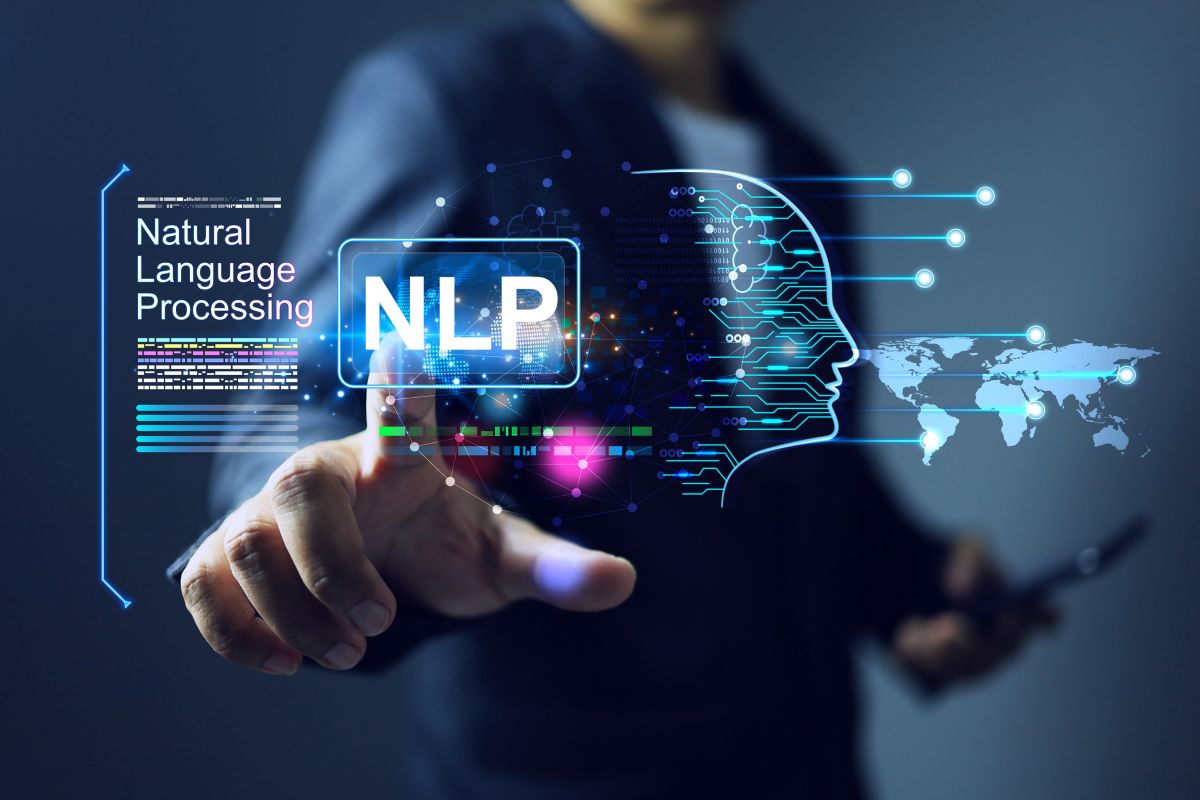
Natural language processing is a part of artificial intelligence (AI) where computers understand and interpret human language, responding in a natural, non-robotic way. It’s often used in business phone systems to understand the caller, interpret their requests and respond.
Natural language processing vs. natural language programming
The NLP meaning is not to be confused with natural language programming. Natural language processing is AI hearing and deciphering human speech and responding appropriately. On the flip side, natural language programming is used to develop software by writing instructions in natural language rather than code. It’s used for software creation at a lower technical barrier.
Common small business applications of NLP
NLP models are used in many small business applications, and those applications are growing. In fact, one market analysis values NLP technology at around $69 billion in 2026 and expects it to triple by 2031.
The biggest NLP use case is in your business phone system, but businesses are increasingly using NLP for a number of business activities. Take a look:
- AI assistants: This is the first introduction to your business when someone calls in. NLP helps virtual assistants answer the call, handle routine questions and schedule appointments in a fluid, conversational manner without the need for a real agent, just like in the above scenario.
- Conversational IVR: This is the modern phone menu. Instead of a numbered menu requiring callers to “Press 1 for Sales,” NLP listens to the caller explain why they’re calling and then routes them to the correct person or department. Behind the scenes, it accounts for things like which agent is free to help the caller and how urgent the caller sounds. This is no longer a fixed menu.
- Voice IVR: This is a fixed menu. While your callers will go through a phone tree and choose options, they can simply say their option instead of pressing buttons.
- Call transcription and summary: NLP is used in AI transcription, where it captures every word of a call and then creates a short summary to be shared across teams for collaboration. It also serves as a searchable written record of a call.
- Chatbot: Just like spoken conversations, NLP is used in text format too on websites or over SMS.
- Voicemail to text: NLP can translate a spoken voicemail into text for you to read.
Natural language processing in customer service
Natural language processing in customer service is a natural fit. Why? Let’s face it, customers are impatient. They want speed so they can move on with their day. When a customer can get answers fast, it improves their customer satisfaction. According to HubSpot research, 90 percent of consumers say that an “immediate” response when they have a customer service question is very important.
NLP delivers that speed. Because it can understand and respond to voice responses in a natural way, it can route callers through a phone system and, in some cases, do away with a menu altogether. It also eliminates the need for callers to repeat themselves to each agent they speak to. And it handles self-service tasks like checking order status, answering common questions and even handling basic support requests.
That said, while speed matters, it’s not all that matters. Human contact is important too. In fact, frustration with AI agents is on the rise, and more people are preferring a real person to an AI agent. It seems the best solution could be a combo of both. AI assistance to speed things up, but with a real person available when needed.
Benefits of NLP
NLP might sound abstract to you, like something for IT, not your day-to-day business, but it could already be working inside the tools you currently use. Plenty of small businesses are already using these generative AI tools, and more plan to adopt them. Here’s what it can actually do for you:
- Fewer missed calls: your calls get answered and routed faster with fewer mistakes.
- 24/7 availability: no more 9-to-5 hours; your callers can get help on nights, weekends and holidays.
- Increased consistency: NLP handles routine questions with ease, providing quality answers every time.
- Urgency detection: NLP can detect when a caller is frustrated or has an urgent need, moving them up in the queue.
- Translation as needed: some sophisticated NLP systems can detect a caller’s language and respond and route the call accordingly.
And finally, perhaps the biggest benefit to your business is that all the above-mentioned benefits of NLP models contribute to better overall customer satisfaction. Businesses already using AI-powered customer service are seeing a 17 percent higher customer satisfaction rating.
Making the most out of natural language processing
There are many useful AI tools. And you don’t need to try them all at once. When it comes to NLP, all you need is a phone system that already has it built in. Test each one based on need. For example, if you’re constantly answering the same question over and over, a virtual assistant is a good starting point. Likewise, if you are battling missed calls, a conversational IVR might be a better place to start.

Learn more about how Ooma Office can help your business.
Thank you!
An Ooma Office Sales Representative will be in touch shortly.
866-573-0707



Learn more about how Ooma Office can help your business.
Just call 877-621-0515 or click this to CHAT. Or, fill out this form and someone will reach out to you shortly.
Husain Sumra is a former journalist who reported on the biggest companies in tech, from Apple to Amazon, covering cloud services, consumer technology and communication solutions. His journalism background has helped him bring a customer-first approach to content marketing, creating pieces of content aimed at helping people.