AI copyright: What businesses need to know about AI-generated content
 | March 17, 2026 | 8 min read |
Key Points
- Purely AI-generated content usually cannot be copyrighted.
- Human editing and creativity can qualify for protection.
- Businesses should treat AI output as draft material.
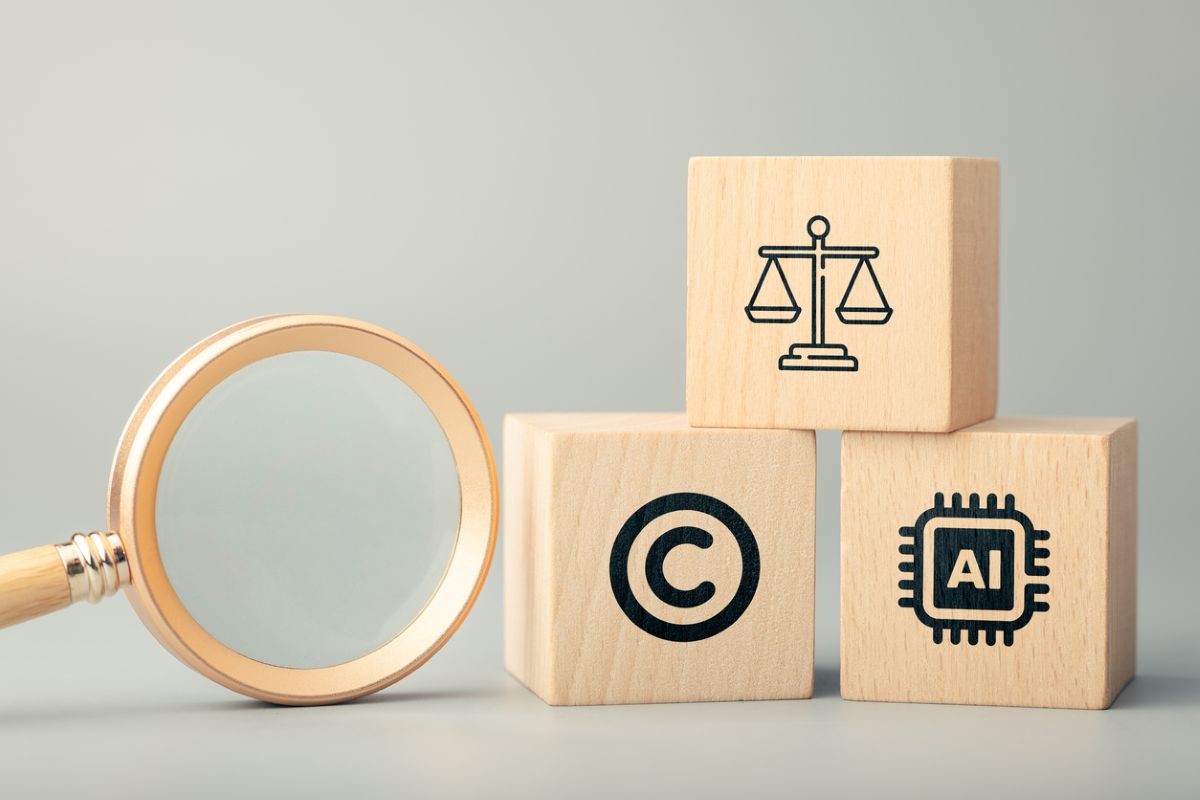
AI can design logos, write blog posts, and create marketing images in seconds.
But here’s the problem: you might not actually own any of it.
The answer to that problem has been evolving rapidly, and it might change in the future, which means it can be difficult to keep up with. But worry not, because in this guide we’ll break down the latest AI copyright updates and how they affect your business and the AI-generated content you create.
Can you copyright AI-generated content?
Purely AI-generated work usually cannot be copyrighted under current U.S. copyright rules.
The U.S. Copyright Office’s official position is that human authorship must be present in order for a work to be copyrighted. A prompt to an AI does not count as authorship in the Copyright Office’s view because the human is not literally authoring it; the AI is.
This view was backed up by the Supreme Court in March 2026 when it declined to hear a case involving AI-generated art. In 2012, computer scientist Stephen Thaler created a piece of art using AI. He applied for a copyright in 2018 but was denied. He sued, and the courts upheld the Copyright Office’s decision, but appeals eventually went to the Supreme Court. Because the Supreme Court declined to hear the case, the issue is settled for now.
If a prompt does not count as human authorship, what does? Here’s one way to think about it. Let’s say a very rich person wants to commission some art for their home. They go to an artist and say they want a portrait of themselves. The artist then creates the painting and gives it to the rich person. Who is the author: the rich person or the painter? Most people would consider the painter the true artist. In this case, the human prompter is the rich person and the AI is the painter.
Now, if a human takes AI-generated material and edits, modifies, or arranges it in a creative way, it may qualify for copyright protection. There does have to be significant work done to an AI-generated piece to qualify. You can’t just take an AI-generated picture of a flower, put it into Photoshop, and add a dot or make tiny adjustments.
Why AI copyright law is so complicated
Copyright law was originally designed to protect human creators. Since the first U.S. copyright law in 1790, protections have expanded to cover everything from books and music to digital media.
The intention is to protect human authorship so that no one else can take credit for or profit from your work without your permission.
That gets more complicated when you factor in AI, because it uses human work in its training data. Companies like OpenAI and Anthropic feed their models with news articles, books, movies, paintings, photographs, and all kinds of content. The AI systems, also known as large language models, then use that information when generating content.
More technically, when you prompt AI, it looks at all that content it has consumed, analyzes what makes it work and why, and then uses probabilities to predict—word by word or pixel by pixel—the best response to your prompt.
The question then becomes: who authored that content? Was it the human who prompted the AI and came up with the idea, or the AI that actually created the content?
It gets even more complicated. AI companies faced more than 70 infringement lawsuits by copyright owners in 2025. Those cases involve some big companies, including Dow Jones v. Perplexity AI, Getty Images v. Stability AI, and The New York Times v. OpenAI & Microsoft. Why? The issue ultimately comes down to fair use, which allows someone to use copyrighted material in limited ways for purposes such as research, news reporting, commentary, or teaching.
While AI companies claim feeding their models with books, articles, music, and more fits into fair use, copyright holders do not agree. The AI companies also say their models are taking copyrighted works and creating something new with them, much like a human would read a book, be inspired, and write their own book. Copyright holders such as Disney and Universal argue that the models can reproduce and distribute copies and derivatives of their intellectual property.
None of these issues are legally settled yet, which raises deeper questions about authorship and creativity in the age of AI. For example, here’s a difficult question all of this creates: if you create a logo with AI and then that AI company is found to have infringed Disney’s copyright, can you still use your logo?
The answer? No one knows. At least not yet.
What this means for businesses using AI
There are both risks and opportunities for businesses using AI, and understanding them can help you navigate this potential minefield.
This is especially important because, according to the U.S. Chamber of Commerce, 58 percent of businesses say they use generative AI, and 65 percent of them are worried about the patchwork of state AI laws.
The risk
Let’s say you use AI to create a logo. You don’t have the time or resources to make a custom one, so you use this AI-generated logo on everything and it works well for your business. Now let’s say your business grows and becomes a trusted brand. Your logo could be considered public domain, which means absolutely anyone can use it and you have no say. There is real potential for your brand to be diluted or hijacked if you can’t copyright something as central as a logo.
The opportunity
Using AI to turbocharge your business is a very real opportunity. As noted above, you can use it when you don’t have the time or resources to make custom logos, ad copy, or flyers. This can save you time and allow you to focus on other key parts of your business, especially if you’re not a creative person yourself.
Why AI copyright will matter more for businesses
Your business is also a brand, and brands rely on intellectual property ownership. If a lot of businesses are built on AI-generated content that cannot be copyrighted, that means your brand defensibility is weakened.
From Disney to Nintendo, the biggest businesses in the world fiercely protect their brands through copyright protections. Could you imagine Disney without Mickey Mouse or Nintendo without Mario? It wouldn’t feel the same.
That’s why a hybrid workflow that doesn’t rely solely on AI is best for your brand. Below, you’ll find out how to do that.
How businesses can use AI-generated content safely
AI copyright may seem complicated, but the basic rule is simple: your business should treat AI-generated content as draft material.
Think of AI outputs as thought starters you can build from. You can use AI to illustrate a vision and then send that draft to an artist who creates a more professional version. You also get the added benefit of working back and forth with the artist to request specific changes. If you’ve ever tried to get AI to make changes to an image, you know it can be a real pain, with the AI sometimes remaking the image into something totally different.
In fact, you should use humans at every level to check and edit AI-generated content. Just because AI can give you something good does not mean you can’t make it great. Add your own spin to it, or hand it off to someone who can.
Of course, there is a caveat. If you are not worried about copyright when it comes to your AI-generated content, that’s okay too. You can use AI-generated content if that is what works for you. However, you should still keep three things in mind:
- All AI-generated content should be checked for quality and consistency.
- Do not assume AI-generated work is copyright protected.
- Document your prompts and all human attempts at authorship.
Keeping records of your work with AI is important, as it can help demonstrate how much authorship you contributed to a work, even if you are not worried about copyright claims in the future.
As long as you keep those three things in mind, navigating the AI copyright wild west becomes much easier.
The future of AI and copyright
There are so many unanswered questions around AI that it’s difficult to tell how many answers we’ll get in the future. While authorship feels settled for now, it is not impossible for that situation to change.
These three questions will shape the future of AI copyright:
- How much human input counts as authorship?
- Will AI training data qualify as fair use?
- Will new laws redefine authorship?
Science fiction could also become science fact. Companies like Tesla are working on humanoid robots powered by AI that could complete tasks and even create art. While copyright law is aimed at humans, what happens if we find ourselves living in a world like I, Robot and those machines are given rights over their creations?
If everyone adopts AI for creation, how does that affect how we as humans view creation? Does it change our perspective on what authorship is and whether human-only creations are worthy? If everyone uses AI for creation, and companies feed those AI creations back into AI, what happens to the quality of AI-generated content? Does it get worse? Better?
These are real questions, and they will likely take the next five to ten years to answer. The New York State Bar Association says it has seen that “there is a pathway forward for works created with AI, but not without nuances and limitations.”
The most pressing future issue for AI is fair use, and whether feeding copyrighted material into these large language models for training purposes is infringement. We’ve already started seeing some news organizations, like The New York Times, announce licensing deals with AI companies.
It’s actually not that complicated
AI may change how content is created, but copyright law still revolves around one core principle: human creativity. Businesses that treat AI as a tool will be best positioned as the law evolves.
Focus on what’s best for your business. If you’re working on branding, add human editing to help future-proof your business. If you need AI to create phone scripts, then feel free to do so. It’s very unlikely you’ll ever need to copyright a phone script, after all.
AI isn’t going anywhere anytime soon, so in the meantime, crack open that chat, take a look at some useful AI tips, and see how you can use it to elevate your business.

Learn more about how Ooma Office can help your business.
Thank you!
An Ooma Office Sales Representative will be in touch shortly.
866-573-0707


Learn more about how Ooma Office can help your business.
Just call 877-621-0515 or click this to CHAT. Or, fill out this form and someone will reach out to you shortly.
Husain Sumra is a former journalist who reported on the biggest companies in tech, from Apple to Amazon, covering cloud services, consumer technology and communication solutions. His journalism background has helped him bring a customer-first approach to content marketing, creating pieces of content aimed at helping people.