The Connectivity Ladder: Is your child ready for a phone?
 | August 20, 2026 | 8 min read |
Key Points
- Smartphone readiness depends on maturity and demonstrated responsibility, not age alone.
- The Connectivity Ladder introduces technology gradually as a child’s communication skills and independence grow.
- A calling-focused phone can help bridge the gap between having no device and receiving a smartphone.
- Parents can reduce conflict by matching digital access to the responsibilities a child is prepared to manage.

Today, one of the toughest decisions for parents isn’t if their child will get a phone.
It’s deciding when.
For some families, this question comes up earlier than expected. The 2025 Common Sense Census: Media Use by Kids Zero to Eight reports that almost one in four children has a cellphone by age 8, and 40% have a tablet by age 2. Meanwhile, the American Academy of Pediatrics recommends avoiding personal screen media for children under 18 months, except for video chatting, and says media should support real-world interaction rather than replace it.
Parents often feel stuck between two different realities.
On one hand, children are becoming more independent at younger ages. They walk home from school, participate in sports, spend afternoons with grandparents and visit friends’ houses.
On the other hand, today’s smartphones do much more than make calls. They are social platforms, gaming devices, entertainment centers, cameras, web browsers and attention-grabbing gadgets, all in one.
This creates a dilemma that millions of families face: My child needs a way to reach me. But are they really ready for everything that comes with a smartphone?
We call this the Connectivity Gap.
What is the Connectivity Gap?
The Connectivity Gap is the period when a child needs to communicate with trusted adults but isn’t ready for unlimited internet access, social media or the constant notifications that come with a smartphone.
Many parents talk about technology as if it’s an all-or-nothing choice. Either a child has no device or they receive a fully featured smartphone. But childhood doesn’t happen all at once. It happens in stages. It stands to reason that technology can grow in stages, too.
That’s the idea behind the Connectivity Ladder. It’s a framework that matches technology to a child’s developmental readiness, not just their age.
Why readiness matters more than age
Age is a table-stakes consideration. Once a child reaches a certain age, it can mark the beginning of conversations about readiness, responsibility and the need for a phone. But while age matters, development matters more.
For example, two children who are both 10 years old may have completely different levels of emotional maturity, impulse control, responsibility and communication skills. One may consistently complete homework, follow family rules and openly discuss difficult situations. The other may still need reminders about daily routines or struggle with peer pressure.
Neither child is falling behind or failing. Both children are simply developing at their own pace.
The National Institute of Mental Health notes that the brain continues developing into the mid-to-late twenties. One of the last areas to mature is the prefrontal cortex, which plays a key role in planning, prioritizing and decision-making.
Shifting the smartphone-readiness conversation away from your child’s age can help make the transition more successful. Instead of asking, “Is my child old enough?” try asking:
Has my child demonstrated the responsibilities that should come before greater independence?
Technology works best when it builds on the independence children have already earned, not when it’s expected to teach responsibility on its own.
That said, age is a concrete measurement, while readiness can feel ambiguous. The Connectivity Ladder provides a framework families can use to navigate that ambiguity.
The Connectivity Ladder: Five steps toward smartphone readiness
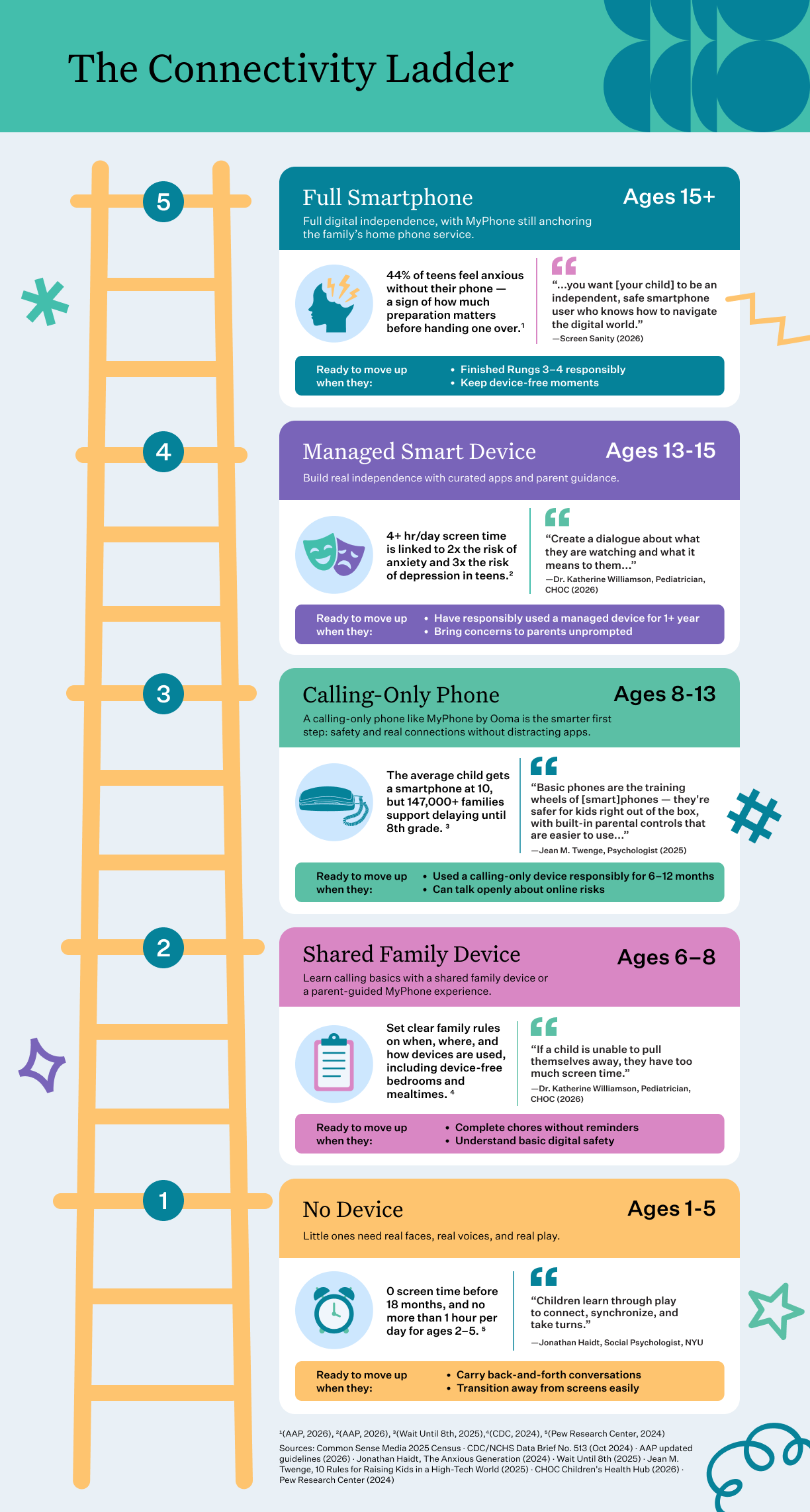
Embed this infographic on your website:
Instead of looking for one “right age” for a phone, the Connectivity Ladder helps families build readiness step by step.
Rung 1: Build relationships before technology
During early childhood, communication develops through conversations, imaginative play, storytelling and face-to-face interaction. Children learn empathy, emotional control and language from interacting with people, not from notifications.
Simple experiences, such as calling a grandparent together on the family phone or a parent’s cellphone, can help children learn about communication without needing their own device.
Signs your child may be ready for the next rung:
- Follows simple family rules.
- Can carry on two-way conversations.
- Transitions away from screens without major distress.
- Participates in regular screen-free family routines.
Rung 2: Learn technology together
Children in elementary school get curious about technology, but that doesn’t always mean they’re ready to use it on their own. Shared family devices create opportunities to learn alongside trusted adults.
Parents can teach children how advertisements work, why personal information matters and why everything online isn’t necessarily true. Modeling good digital habits is also an excellent way to show children what a healthy relationship with technology can look like.
“Parents and caregivers can model responsible and healthy social media use, including by limiting their own use, being mindful of social media habits and modeling positive behavior on social media accounts.”
Source: U.S. Surgeon General’s Advisory on Social Media and Youth Mental Health
The American Academy of Pediatrics emphasizes looking beyond minutes alone when families evaluate children’s media use. The content, context and conversations surrounding technology also matter. Shared family technology gives parents opportunities to teach digital literacy, practice healthy habits and build communication skills before children begin using devices independently.
This stage is less about counting every minute and more about building healthy habits. Indicators that your child may be ready for the next rung include:
- Completes everyday responsibilities with minimal reminders.
- Communicates openly with caregivers when something doesn’t feel right.
- Demonstrates consistency in making responsible choices.
- Understands basic digital safety.
- Has a genuine need for independent communication.
- Feels comfortable speaking on the phone with trusted adults.
- Accepts “not right now” without major conflict.
Ask yourself
If your child accidentally dialed the wrong number or encountered an unexpected situation, would you trust them to handle it calmly or ask for help?
Rung 3: Build communication before introducing distraction
This is where many families experience the Connectivity Gap. Children may genuinely need to contact parents after school, during sports or while visiting friends. However, needing to communicate doesn’t mean a child needs social media, web browsers or app stores.
A calling-focused phone allows children to:
- Reach trusted adults.
- Practice real conversations.
- Build confidence speaking on the phone.
- Learn responsibility without being distracted by digital features throughout the day.
The nonprofit Wait Until 8th encourages families to delay giving children smartphones until at least the end of eighth grade. More than 147,000 families have signed the pledge, reflecting growing interest in delaying smartphone adoption.
“Consider a basic cell phone like a go-cart. Kids can satisfy their growing need for speed, while helmets, seatbelts and track barriers provide important safety guardrails.”
Source: Screen Sanity Smartphone Roadmap
Signs your child may be ready for a managed smartphone:
- Has used a calling-focused phone responsibly for at least six to 12 months.
- Can explain common online risks and how to respond to them.
- Demonstrates healthy self-control with technology and other responsibilities.
- Goes to trusted adults when something online feels confusing or uncomfortable.
- Has increasing independence that creates a legitimate need for additional digital tools.
Rung 4: Add independence with guardrails
As children become teenagers, technology increasingly supports school, extracurricular activities, friendships and organization. This can be an appropriate time to begin providing more digital independence while maintaining family expectations, parental oversight and regular conversations.
Research published by the CDC’s National Center for Health Statistics found that teens reporting four or more hours of daily recreational screen time were more than twice as likely to report symptoms of anxiety and nearly three times as likely to report symptoms of depression compared with peers reporting lower screen time.
Screen time alone doesn’t determine mental health, and the findings don’t establish that screen use caused those symptoms. However, they reinforce the importance of helping teens build balanced technology habits.
Ask yourself
If your child received an unexpected message from someone they didn’t know or saw something online that made them uncomfortable, would they be more likely to hide it or bring it to you?
Rung 5: Prepare for independent digital citizenship
Eventually, every young person will need to navigate technology independently. At this stage, parents move from being gatekeepers to being coaches. Healthy conversations continue and family expectations remain clear, but more responsibility belongs to the teenager.
Before a child leaves home, the goal is for them to become an independent and safe smartphone user who can navigate the digital world in a healthy and responsible way.
Source: Screen Sanity Smartphone Toolkit
What happens when families skip important rungs?
There isn’t one perfect parenting path, and every child develops differently. But giving a child more technology than they’re ready for can make it harder to build healthy habits later.
Instead of adding responsibilities gradually, parents may realize that certain features are problematic only after those features have become part of the child’s daily life. Removing or disabling access can then become a source of frustration and conflict.
The phone itself isn’t necessarily the problem. Conflict often happens when expectations, access and readiness don’t match.
The Connectivity Ladder encourages families to build communication skills before adding digital complexity.
What the Connectivity Ladder looks like in real life
Consider how two families might approach phone readiness differently.
Emma, age 9
Emma walks home from school twice each week and occasionally spends afternoons at a friend’s house. She follows family routines consistently and enjoys talking with her grandparents on the phone.
She needs a reliable way to reach her parents.
She doesn’t need social media.
For Emma, a calling-focused phone may be the right next step.
Marcus, age 13
Marcus has used a calling-focused device responsibly for more than a year. He understands online privacy, talks openly with his parents about what he encounters online and has demonstrated good judgment with shared family technology.
For Marcus, a managed smartphone with clear expectations may be an appropriate next step.
Notice that readiness for each child is not just about age. It also depends on demonstrated responsibility and discernment, confident communication skills and the digital literacy needed to use technology well.
The Connectivity Ladder encourages families to see technology as something children grow into, not something they receive all at once. When communication grows alongside responsibility, technology can become a tool that supports childhood rather than competing with it.
Looking for a first phone without the distractions?
For many families, the Connectivity Gap begins with one simple need: staying connected.
A calling-focused home phone such as MyPhone by Ooma gives children a reliable way to communicate with trusted family members while allowing parents to introduce independence gradually.
Features such as trusted contacts, Quiet Hours, parental controls and multiple family numbers can help children build communication skills before taking on the additional responsibilities of a full smartphone.
Husain Sumra is a former journalist who reported on the biggest companies in tech, from Apple to Amazon, covering cloud services, consumer technology and communication solutions. His journalism background has helped him bring a customer-first approach to content marketing, creating pieces of content aimed at helping people.