The case for giving kids a direct line to their closest friends
 | November 19, 2026 | 7 min read |
Key Points
- A screen-free home phone lets kids call approved friends and family without borrowing a parent’s smartphone.
- Making calls gives children opportunities to practice conversation skills and independence.
- MyPhone’s Trusted Circle lets parents manage approved contacts, while Quiet Hours silences incoming calls during chosen times.
- Start with one friend, agree on calling times and help your child practice phone etiquette.
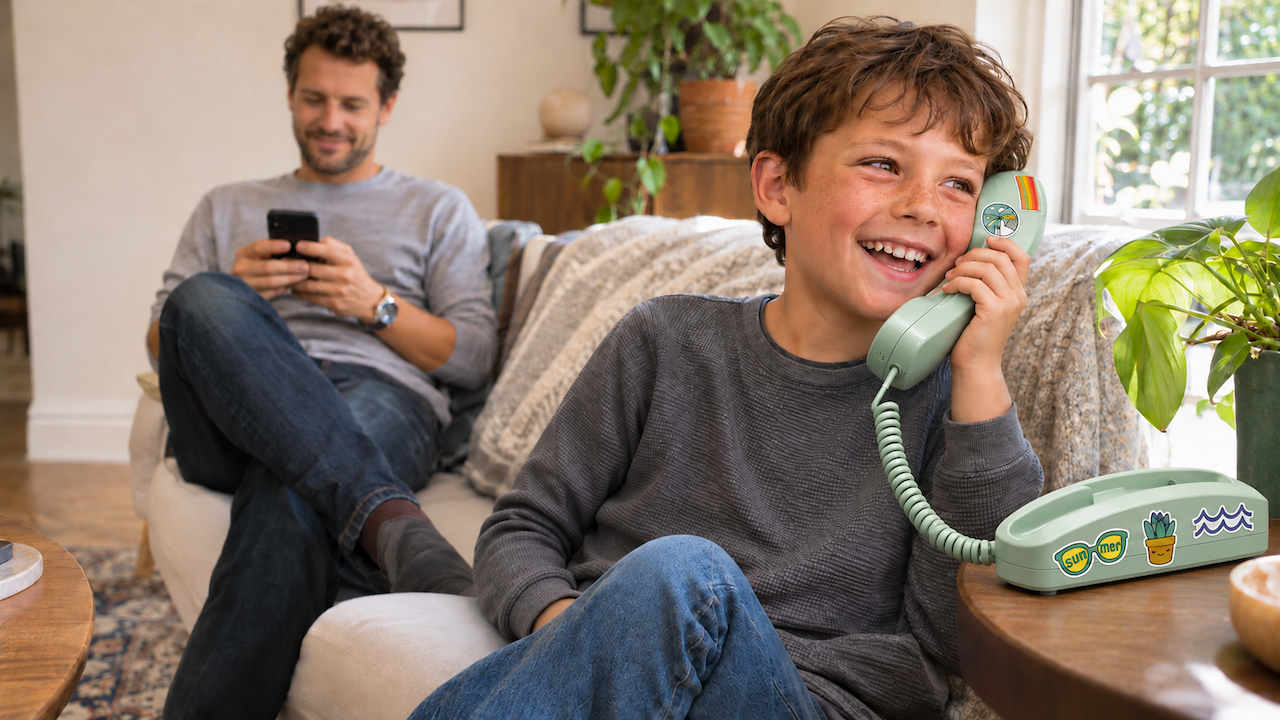
“Can I call my friend?” It’s a simple enough request, except if you happen to be using your phone to follow a recipe or waiting on an important call back from your doctor. You hand it over when you can, only to realize minutes later you need to make sure to schedule that important meeting tomorrow. By then your child wandered into another room with it.
It’s enough to make holding off on giving your child a smartphone feel inconvenient. However, getting them a smartphone presents an awkward gap: You want your child to reach their friends, but you’re still deciding when apps, group chats, and internet access belong in their day. For now, having them catch up with their friends on borrowing your phone and finding a moment when both households can make it happen.
A screen-free home phone with parental controls is one way to make room for those conversations. With a little setup and a few shared expectations, your child can start reaching out to approved friends and family more independently, while you keep the boundaries that work for your household. And yes, you get to keep your own phone.
Sometimes they just want to tell someone about their day
Adults tend to think of calling as something we do with a purpose. We need to confirm a plan, ask a question, or share some news. Children’s reasons can sound a little less urgent: they want to tell a friend what they missed out on when they had to go home early. They remembered a joke from lunch they have to share with someone. They want to discuss, at considerable length, what they just created in Minecraft.
If you’ve ever listened to some of these conversations, you know they can be wonderfully uneventful. To your child, though, they’re everything. That friend gets it. They know the people in the story. They remember the joke. They have equal excitement about the new mods they just added.
As clinical psychologist Eileen Kennedy-Moore, PhD, explains in the American Psychological Association’s Monitor on Psychology, “Friendships are fascinating developmentally because they are how children start to discover who they are beyond their family of origin.” A phone call gives children another opportunity to enjoy those relationships between the times they can be together. That can be especially welcome when a close friend changes schools or a favorite teammate lives across town.
A little independence starts with making the call
There’s a small but meaningful difference between asking a parent to send a message and reaching out yourself. A child who makes the call gets to decide how to start. They can ask about their friend’s day, explain an idea, or say, “Do you want to come over Saturday?” You still approve Saturday’s plans and coordinate with the other parent, but your child gets to take the first step. That can make them feel somewhat independent, perhaps even helping their confidence.
Finding those opportunities isn’t always automatic. In a 2023 C.S. Mott Children’s Hospital poll, 38% of parents to children ages 5–8 said established family habits got in the way of letting their child do things independently. It’s easy to keep doing something because you’ve always done it. Making a familiar call is one task you can gradually hand over.
Picture a first call where your child asks you to stay nearby. You practice what to say if a friend’s parent answers: “Hi, it’s Sam. Is Alex available?” The conversation lasts two minutes, and afterward your child needs reassurance that it went okay. On a later call, they dial and introduce themselves without asking for help. That’s the kind of small step you can give them room to practice.
Some children will take to calling quickly; others will want support for longer. You can offer an opening line, help them think of something to ask, or simply be nearby. As they get comfortable, let them do more of the talking themselves. You can even gradually move yourself away if you sense them getting comfortable. For example, you can start out being nearby and paying sole attention to them. You can then graduate to just being in the same room while doing other tasks.
You get your phone back and a little breathing room
There’s a practical reason to like this arrangement, too: your phone stays with you, so you can finish ordering groceries or take the call you’re expecting. You’ll also spend less time playing messenger. Your child can directly ask their friend which book they were talking about rather than have you text their parents.
Once calling becomes familiar, there may be afternoons when your child is happily chatting away with their besties. Your child will gain privacy that helps them nurture their friendships while you can focus on your own tasks.
Giving your children some privacy and avoiding overhearing their conversations is important, as it can help them foster their growing independence, according to the Raising Children Network. This will also help you build mutual trust as they grow older.
Sure, you may still hear, “They’re not answering!” and need to help dial a number or end a long conversation. Even so, it’s reasonable to appreciate the moments when a little more independence for your child also makes your day easier.
A phone call can be enough for this stage
If your child mostly wants to talk to a few people they already know, a screen-free phone can meet that need. They can pick up, call, talk, and hang up. There’s something appealing about that simplicity, especially before they’re exposed to the number of communication options a smartphone provides.
Voice itself may also be part of the appeal. In experiments with adults, researchers Amit Kumar and Nicholas Epley found that conversations that included voice created stronger social bonds than text-based exchanges, without the extra awkwardness participants expected.
For parents considering this kind of setup, MyPhone is one option. Its Trusted Circle settings let you approve incoming contacts and choose to limit outgoing calls to that same list. Quiet Hours can silence incoming calls and send them to voicemail during times you choose. The useful question is how that would fit your day. Perhaps your child calls a friend after homework, while evenings and bedtime stay quiet.
Make it work in your household
Start with your child’s immediate friend group, or maybe if they have one or a few best friends. Check with their caregivers about the best number and a reasonable time to call. The friend doesn’t need the same device. They might answer on a household phone or borrow a caregiver’s mobile. If that means the other parents still needs to arrange access, acknowledge it and find a routine that works for both homes.
Keep the expectations simple and decide together when it’s okay to call and when it’s time to finish. If siblings share the phone, talk about how to take turns before arguments may ensue.
It’s also worth practicing what happens when nobody answers, because a missed call can feel personal. Explain that their friend might be eating, at practice, or busy with someone else. Leave a message if appropriate and try again later. Repeated calls won’t make them available sooner.
Choose somewhere your child can talk comfortably, with your household’s noise level and their readiness in mind. Explain your supervision expectations while giving them room to enjoy the conversation without an audience. A phone in a shared space can still allow a little breathing room if everyone gives the caller some space.
Stay available when feelings get complicated, since screen-free conversations can still include misunderstandings. As pediatric psychologist Ranya Alnatour, PsyD, advises through Children’s Health, “Helping a child identify their emotions and cope with big emotions is a really important skill needed to maintain a healthy friendship.” And let your child have preferences. Some will happily talk for half an hour. Others will want a brief hello. Calling can be an invitation without becoming another activity they have to perform.
It starts with one friend
Learning to talk on the phone can be overwhelming for a child. You don’t need to organize calls with the whole class; you can start small with one friend. Agree on a convenient time with their caregiver. Help your child start the conversation, then give them a chance to lead. A short call is a great start.
Over time, those calls can become an ordinary part of the week: a chance to share a story, ask a question, or laugh about something only the two of them find funny. Hearing that laughter from the next room while you get on with your afternoon is a small, very practical reason to make room for a direct line to a friend.
Husain Sumra is a former journalist who reported on the biggest companies in tech, from Apple to Amazon, covering cloud services, consumer technology and communication solutions. His journalism background has helped him bring a customer-first approach to content marketing, creating pieces of content aimed at helping people.