Surgeon General warns about excessive screen time and youth mental health
 | May 22, 2026 | 7 min read |
Key Points
- Excessive screen time can impact kids’ sleep, mental health, and attention spans.
- Parents feel pressure to keep kids connected while limiting harmful digital habits.
- Many families are turning to simpler, communication-focused technology solutions.

For many parents, smartphones have become both a lifeline and a source of stress.
Phones help families stay connected, coordinate schedules, and give children a sense of independence. They can make parents feel safer when kids are walking home from school, heading to practice, or spending time with friends. But at the same time, many families are growing increasingly concerned about the nonstop distractions, emotional pressure, and excessive screen time that often come with smartphones and social media.
That tension is becoming harder to ignore.
In May 2026, the U.S. Surgeon General expanded earlier warnings about social media and youth mental health to include broader concerns around excessive screen exposure overall. The updated guidance highlights how too much screen time may negatively affect sleep, school performance, physical activity, emotional development, and in-person relationships.
For many families, the challenge is no longer whether kids should use technology, it’s how to stay connected without being constantly connected. How to avoid the trap of addictive designs built into many modern apps and devices.
Parents feel caught in the middle
Today’s parents are navigating a difficult balancing act. Many worry that delaying smartphones could leave their children feeling socially isolated or excluded from peer groups. At the same time, parents are increasingly concerned about the emotional and mental health effects of constant connectivity.
A recent Pew Research Center study found that 44% of concerned parents believe social media has become one of the biggest negative influences on teen mental health, even while acknowledging that phones play an important role in their children’s social lives.
This creates a difficult reality for families. Smartphones often feel less like a choice and more like a social expectation. As “The pressure among children to have smartphones starts earlier than many parents expect.”
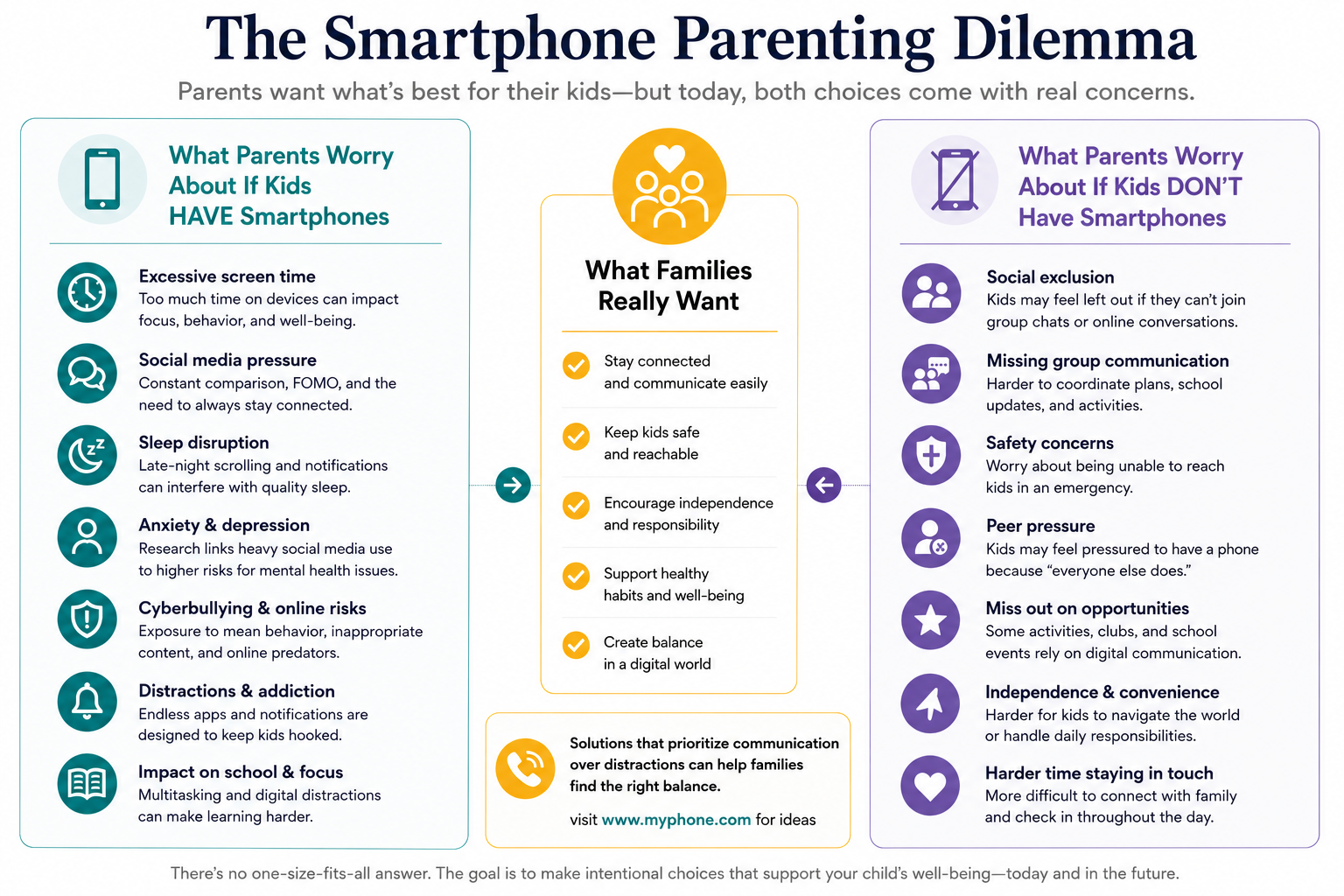
A middle school parent may feel pressured to give their child a smartphone simply because “everyone else already has one.” Another parent may worry about their teen feeling left out of group chats, sports communication, or social events without constant access to messaging apps and social platforms.
At the same time, many teens themselves report feeling overwhelmed by the pressure to stay constantly connected online. Notifications, streaks, social updates, and group chats can create an environment where disconnecting feels socially risky, even when kids recognize they need a break. The fear of missing out, FOMO, can create an anxiety that pushes you to stay connected beyond your limits.
According to CDC data, roughly half of U.S. teenagers report four or more hours of recreational screen time daily, not including schoolwork.
The issue is no longer just screen time. It’s the growing expectation that kids should always be reachable, always online, and always socially available. That constant need to always be socially on is exhausting, draining social batteries to a point where you become more irritable and tired.
It’s not just social media anymore
While platforms like TikTok, Instagram, Snapchat, and YouTube remain part of the conversation, health experts now emphasize that the broader issue is continuous digital stimulation.
Today’s kids often move constantly between streaming videos, online games, messaging apps, and social feeds without much downtime in between. That nonstop engagement can leave less room for sleep, physical activity, creative play, and face-to-face interaction.
A high school student might open their phone to respond to a text from a friend, then quickly get pulled into social media notifications, videos, and endless scrolling for the next hour. What starts as communication can easily turn into passive screen consumption.
Referred to as dopamine-scrolling, infinite timelines, pulling to refresh, short form video and more can lead to fragmented attention, mental distraction, degraded social interaction, and potential issues like anxiety and depression, according to a study from the University of Chichester. Together with doom-scrolling, the issues get worse: chronic stress, lower self-esteem and more, especially when screen use impacts sleep, exercise or in-person social interaction.
The U.S. Surgeon General’s 2023 advisory on social media and youth mental health reported that adolescents who spend more than three hours daily on social media may face double the risk of poor mental health outcomes.
The sleep problem many families recognize
One of the most immediate effects many parents notice is disrupted sleep.
Late-night scrolling, notifications, videos, and constant digital stimulation can make it difficult for children and teens to fully disconnect before bed. Blue light exposure from screens can also interfere with melatonin production and disrupt the body’s natural sleep cycle.
A parent may think their child went to bed at 10 p.m., only to discover they stayed awake for another two hours watching videos, checking messages, or scrolling through social media.
Research increasingly shows that screen use before bedtime can negatively affect both sleep quality and sleep duration in children and adolescents. A peer-reviewed review published through the National Institutes of Health found consistent associations between increased screen time and delayed sleep onset, shorter sleep duration, and poorer overall sleep quality among school-aged children.
Poor sleep has been linked to lower academic performance, mood instability, difficulty concentrating, and increased anxiety. Because of this connection, the American Academy of Sleep Medicine recommends limiting screen use before bedtime and keeping devices out of bedrooms overnight.
Using devices before sleeping is an insidious way to disrupt sleep quality because so much of sleep relies on patterns. If your body gets used to doses of blue light and dopamine for two hours before bed, it will always need it before falling asleep. This is why experts say a bed time routine that includes putting away devices and avoiding drinking or eating for a time before sleeping is essential.
Why families are exploring simpler technology options
Many parents are not looking to eliminate technology entirely. Instead, they are searching for healthier ways to stay connected without introducing all the distractions that often come with unrestricted smartphone use.
That’s one reason some families are becoming more interested in simpler communication tools and transitional technology solutions.
For younger kids especially, parents may want the ability to call or text family members without immediately opening the door to social media, streaming apps, endless notifications, and constant online engagement.
This is why families are exploring simpler communication-first devices like MyPhone by Ooma, which can support healthier digital habits while still allowing children to stay connected.
Rather than encouraging more screen time, MyPhone is designed around communication first. Features like dedicated phone numbers, calling access, and family connectivity can help children maintain independence and reach family members without relying entirely on smartphones and social media platforms for everyday interaction.
For some families, this creates a more gradual transition into technology use.
For example, a child who walks home from school may only need reliable calling access to check in with parents safely. Another family may want grandparents and children to stay connected regularly without introducing younger kids to social media apps too early.
In situations like these, simpler communication tools can provide many of the benefits parents want from technology without all the additional digital noise.
Supporting healthier digital habits at home
The American Academy of Pediatrics emphasizes that healthy digital habits are not about eliminating technology entirely, but about creating balance and ensuring screens don’t replace sleep, physical activity, family connection, and other healthy behaviors.
Children and teens still need opportunities to communicate, build independence, and maintain social relationships. But many parents are now asking an important question: how can families encourage healthy connection without encouraging constant screen dependence?
Simple changes can make a meaningful difference. Many families are creating device-free dinners, setting screen-free bedtime routines, encouraging outdoor activities, and prioritizing more face-to-face conversation at home.
Parents can also help by modeling healthier technology habits themselves and having more open conversations with children about social pressure, online expectations, and digital boundaries.
According to the American Academy of Pediatrics, creating intentional family media plans can help children build healthier long-term relationships with technology.
Final thoughts
Technology is an important part of modern life, and digital tools can provide communication, education, entertainment, and connection. But growing evidence suggests that excessive screen time and constant digital engagement can negatively affect children’s mental and emotional well-being, especially when it replaces sleep, physical activity, and real-world interaction.
For many families, healthier technology habits may depend less on removing screens entirely and more on creating intentional boundaries around when, why, and how children stay connected.
As parents continue navigating the social pressure surrounding smartphones and digital connection, many are looking for more intentional ways to help children stay connected without becoming constantly consumed by screens.
Thank you!
By subscribing to Ooma’s Blog, you can expect to receive insightful emails about latest updates, helpful tips, and useful tricks.
Call us at: 866-573-0707 for any other inquiries
Unlock the full potential of your Ooma experience: Tips and Insights from the Ooma Blog
Alicia Kalnawat, brand marketing manager at Ooma, is an experienced marketing professional driving successful multi-channel campaigns, product launches and creative strategy. She joined Ooma in 2022, bringing hands-on experience from the commercial real estate and insurance industries.